
Harvester and forwarder: getting shift data out of the woods without cell signal
StanForD, USB stick, modem and satellite: the paths machine data can take to the office, and what fits in each one.
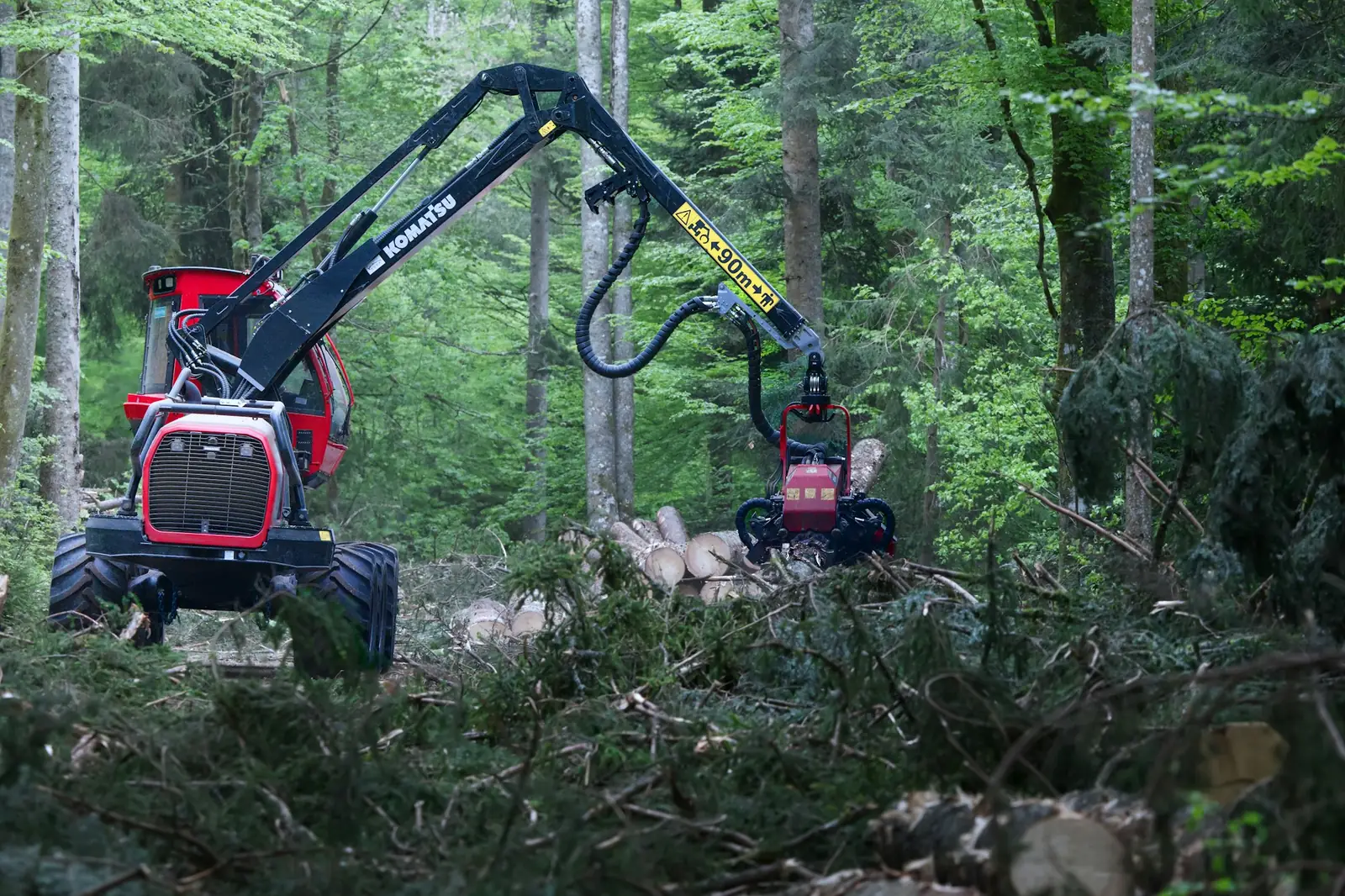
A modern harvester is a computer on tracks or wheels. Every tree it processes becomes a record: diameter, length, volume, assortment. The forwarder records loads and cycles. The problem is rarely that the machine does not know; it is that the office only finds out days later, because the harvesting front has no cell signal.
The standard the machine already speaks
The major forest machine manufacturers have adopted StanForD, a communication standard maintained by Skogforsk, the Swedish forestry research institute. In the current version, StanForD 2010, the machine writes standardized files, such as the harvested production file (hpr) and the operational monitoring file (mom), which records the machine’s time in each state.
This means that production and time data exists and has a known format. The only question is how it reaches the office.
Path 1: USB stick and pickup truck
Still the most common path today. The supervisor comes by, copies the files and takes them back. It works, it is cheap and it is slow: the data arrives when someone goes to fetch it, and in a week of rain or heavy workload, nobody goes. That is why the paper report still rules the meeting.
Path 2: a modem on the machine
Many machines leave the factory with a cellular modem and a manufacturer portal. When there is signal, the data uploads on its own. On a front without coverage, the modem stores the data and sends it when the machine passes a point with signal, which may only happen when the front is finished.
Two limitations: a mixed fleet, with one portal per brand, and the dependence on signal.
Path 3: satellite for the summary
Satellite networks for IoT carry small messages. They are not a path for the full production file, but they are perfect for the summary that drives the day:
- start and end of the shift;
- engine and working hours;
- stops, with time, location and reason;
- machine position.
With that, mechanical availability, operational efficiency and the location of every machine are on the dashboard every day, even on the most isolated front. On the DG satellite network, which we use, the summary arrives in minutes, stamped with the time of each event.
The architecture that combines all three
- Shift summary over satellite, every day, from any front.
- Full file whenever there is signal, through the machine’s modem or a collection point on the road.
- USB stick as a backup, not as routine.
That way the daily indicator does not depend on anyone going out to fetch it, and the tree-by-tree production detail arrives when the path allows.
What the project agreement needs to cover
- Which machines, brands and onboard computer versions.
- Whether the data comes from the StanForD file, the machine bus or a dedicated sensor.
- Who owns the data and who can access it, especially when the machine belongs to a contractor.
- How quickly each piece of information has to arrive: the summary in minutes, over the satellite network; the full file whenever there is cell signal.
Where IoTData fits in
Our own sensors and equipment on each machine for hours, stops and position, with the summary sent over the DG satellite network. Reading each brand’s production file is assessed in the site survey. See telemetry for forest harvesting and the math behind mechanical availability and efficiency.
Sources: StanForD 2010, communication standard for forest machines maintained by Skogforsk (harvested production and operational monitoring files); general characteristics of satellite networks for IoT (short messages).