Commercial truck and bus drivers in the US may not text or hold a mobile phone while driving, and carriers may not allow it. A violation follows the driver and the company. The camera warns on the spot, before the fine and before the crash.
Three facts about fatigue and distraction at the wheel.
The law limits driving time and bans the phone in hand. The EU already requires drowsiness warning from the factory. None of them installs the equipment for you.
That is the regular daily rest for a truck driver in the EU; in the US, a driver needs 10 consecutive hours off duty before driving again. Rest logged on paper does not stop a microsleep on the road: the camera measures what the clock cannot.
In Europe, a driver drowsiness and attention warning has been mandatory on every new car, bus and truck since July 2024, and an advanced driver distraction warning since July 2026. The rule applies to new vehicles: the fleet already on the road is not required to retrofit, so installing is the company’s decision.
Five behaviors, one in-cab alert and one record on the dashboard.
Detection runs inside the camera, with no need for signal. The driver is warned at once; the manager receives the event with the time, the location and, when there is cellular signal, a short clip of the moment.
Drowsiness and fatigue
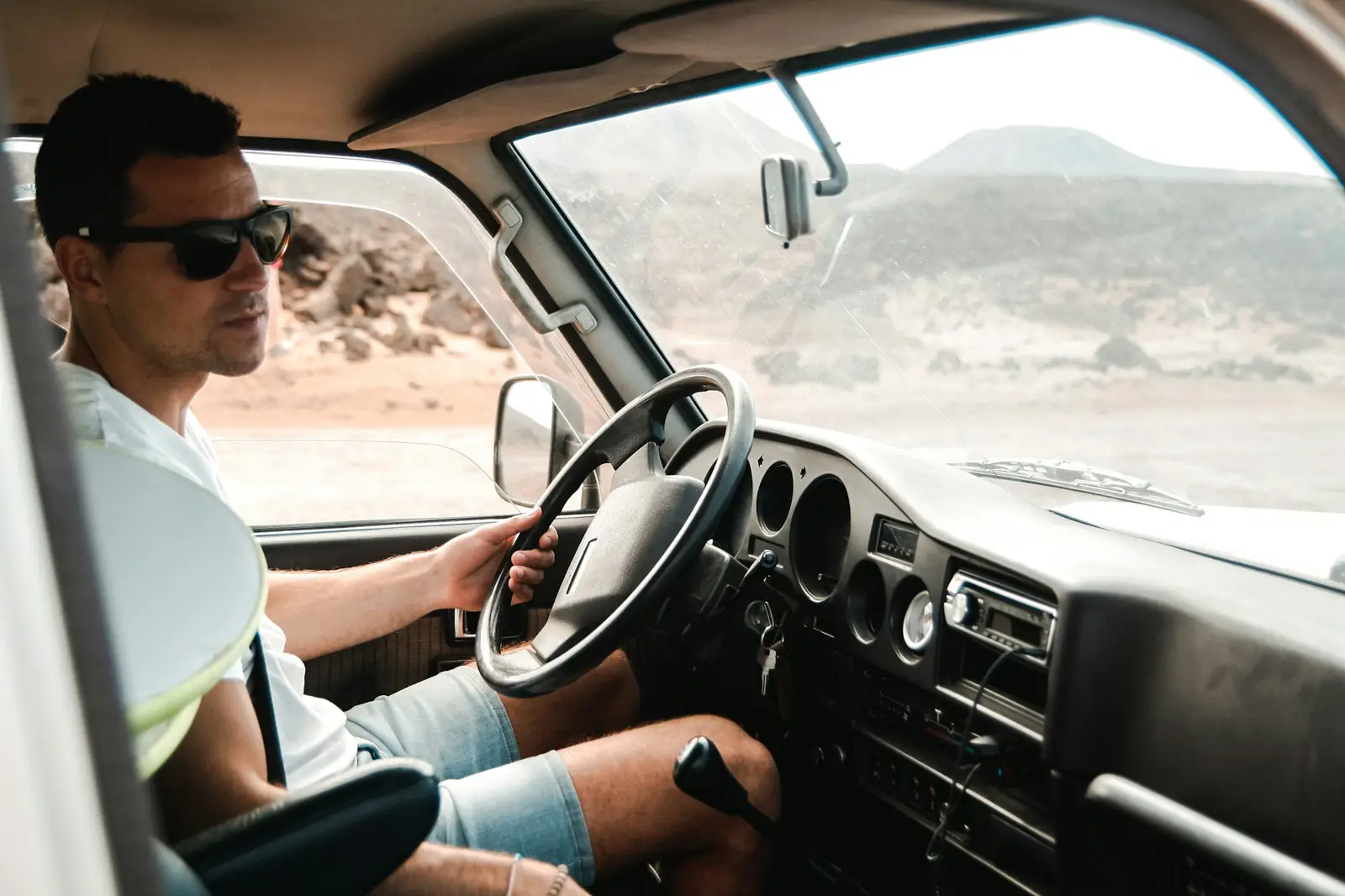
Eyes closed longer than a blink, repeated yawning, a head that drops. The camera lights the face with infrared, so it works at night and with most glasses.
Phone use
Phone in hand or at the ear while the vehicle is moving. Audible alert in the cab and an event record for the conversation with the driver.
Distraction
Looking away from the road, down or to the side, for longer than the configured limit. It is the behavior behind a large share of rear-end collisions.
Smoking
Smoking in the cab, a safety rule at many companies and critical when hauling fuel and hazardous materials.
Pedestrian ahead
The road-facing camera recognizes a person ahead of the vehicle and alerts the driver. It matters most in yards, ports, job sites and distribution centers, where people and machines share the same ground.
Video telematics
The event reaches the dashboard with the tracker’s time, location and speed; the short clip uploads over the cellular network. Without signal, it is stored on the device and uploads when the signal comes back.
- 02:41Fatigue: eyes closed beyond the limit. Audible alert in the cab Alert
- 02:41Event sent to the manager, with location and speed Cellular
- 02:56Second fatigue alert in 15 minutes Alert
- 03:05Stop at a truck stop logged by the tracker: 40 min Cellular
- 07:12Phone in hand at 40 mph. Audible alert Alert
Illustrative example. The limits for each detection are set with the company during the pilot.
Deploying a camera also means starting a conversation.
- 01
Survey
Vehicle type, shifts, routes, existing trackers and safety policy, and what your customer or insurer asks for.
- 02
Policy and privacy
Before installing: what the camera records, who sees it, how long it is kept and how drivers are informed (in Europe, under the GDPR). A simple signed document prevents the problem that technology alone creates.
- 03
Pilot
A few vehicles, limits tuned so it does not beep for nothing, and the first month reviewing events together with the operation.
- 04
Operation
Reports per driver and per shift, a routine for talking through events, and support from the team that installed it.
We are honest about what is ours. The camera is ours: board, detection firmware, integration with the tracker and the platform, alert rules, reports and support, by the same team at Data Frontier in Brazil. And no camera replaces rest: it warns, the driver is the one who stops the truck, and the company is the one who guarantees the schedule. Video does not travel over the satellite network; outside cellular coverage, the event is stored and uploads when the signal returns, while the position keeps flowing over the DG satellite network, in minutes.
The usual questions, answered plainly.
Does the fatigue camera work at night and with sunglasses?
At night, yes: the camera lights the face with infrared, invisible to the driver. With regular glasses, usually too. Some dark lenses block infrared and get in the way of reading the eyes; in those cases the camera still picks up head nodding and yawning. The pilot shows how it performs in your fleet.
Does the camera record the driver all the time?
That depends on the configuration, decided before installation. The usual setup keeps only the clip around each event. What is recorded, who watches it and how long it is kept goes into the company policy, with drivers informed, as data protection law requires (the GDPR, in Europe).
Do I need cellular signal?
Not to detect and alert: that happens inside the camera. For the video to reach the dashboard, yes. Without signal, the event is stored and uploads when the vehicle is back in coverage.
Does it work on forklifts and yard machines?
Pedestrian detection does, and that is where it prevents the most accidents: yards, ports and distribution centers. Fatigue detection makes sense for people who drive for hours on end.
Is it required by law?
For the fleet already on the road, generally not. In the EU, new vehicles must leave the factory with drowsiness and distraction warnings, but there is no obligation to retrofit. What the law does require is driving and rest limits. The camera is the company’s decision and, sometimes, a requirement from a customer or insurer.
Tell us how many drivers you have and what shifts they run.
An answer from an engineer, not a bot. If you already have trackers, tell us which: the camera events land on the same dashboard.
The same hardware and the same dashboard, in other sectors.
Sources: 49 CFR 392.80, 392.82 and 395.3 (FMCSA) · Regulation (EC) No 561/2006 · Regulation (EU) 2019/2144 · Regulation (EU) 2016/679 (GDPR).